Skip to content

Desi banjara

learn and grow together

  • Azure
    • Azure Compute
      • Azure Logic Apps
      • Azure Mobile Apps
      • Azure App Service
      • Azure Serverless Computing
        • Azure Functions
    • Azure Networking services
      • Azure Networking – VNET
    • Azure Database Services
      • Azure SQL
      • Azure Data Factory
      • Azure Databricks
    • Azure Analytics Services
    • Azure Cognitive Services
    • Azure Data and Storage
    • Azure Devops
    • Azure landing zone
    • Azure IaaS
    • Azure Internet of Things (IoT)
      • Azure Machine Learning
      • Azure AI and ML services
    • Azure Migration
    • Microsoft Azure Log Analytics
  • Azure Security
    • Azure Identity and Access Management
    • Azure Active Directory
    • Azure Defender
    • Azure security tools for logging and monitoring
    • Azure Sentinel
    • Azure Sentinel – Data connectors
  • Agile Software development
    • Atlassian Jira
  • Amazon Web Services (AWS)
    • Amazon EC2
    • Amazon ECS
    • AWS Lambda
  • Google
    • Google Cloud Platform (GCP)
    • gmail api
    • Google Ads
    • Google AdSense
    • Google Analytics
    • Google Docs
    • Google Drive
    • Google Maps
    • Google search console
  • Software architecture
    • Service-oriented architecture (SOA)
    • Domain-Driven Design (DDD)
    • Microservices
    • Event-Driven Architecture
    • Command Query Responsibility Segregation (CQRS) Pattern
    • Layered Pattern
    • Model-View-Controller (MVC) Pattern
    • Hexagonal Architecture Pattern
    • Peer-to-Peer (P2P) pattern
    • Pipeline Pattern
  • Enterprise application architecture
  • IT/Software development
    • API development
    • ASP.Net MVC
    • ASP.NET Web API
    • C# development
    • RESTful APIs
  • Cybersecurity
    • Cross Site Scripting (XSS)
    • Reflected XSS
    • DOM-based XSS
    • Stored XSS attacks
    • Ransomware
    • cyber breaches
    • Static Application Security Testing (SAST)
  • Interview questions
    • Microsoft Azure Interview Questions
    • Amazon Web Services (AWS) Interview Questions
    • Agile Software development interview questions
    • C# interview questions with answers
    • Google analytics interview questions with answers
    • Javascript interview questions with answers
    • Python interview questions with answers
    • WordPress developer interview questions and answers
  • Cloud
    • Cloud computing
    • Infrastructure as a Service (IaaS)
    • Platform as a Service (PaaS)
    • Software as a Service (SaaS)
    • Zero Trust strategy
  • Toggle search form
  • Azure Mobile Apps Azure Mobile Apps
  • How to Write an AI-Generated Article That Feels 100% Human Using ChatGPT AI Writing & Automation
  • Azure Kubernetes Service (AKS) Azure Kubernetes Service (AKS)
  • Microservices pattern Microservices
  • Azure Security Information and Event Management (SIEM) Azure Security Information and Event Management (SIEM)
  • IBM QRadar: Empowering Security Operations with Advanced Threat Intelligence and Analysis SIEM
  • Google Cloud Platform (GCP) Google Cloud Platform (GCP)
  • How FinOps evaluates the cost efficiency of architectures in cloud? Cloud

Hexagonal Architecture

Posted on March 23, 2023March 23, 2023 By DesiBanjara No Comments on Hexagonal Architecture

Hexagonal architecture, also known as ports and adapters architecture, is a software design pattern that separates the application logic from the external dependencies such as databases, user interfaces, and other services. This allows for greater flexibility and modularity in the application, making it easier to maintain and extend over time.

In a hexagonal architecture, the application is organized around the core business logic, which is surrounded by a set of ports and adapters that connect the application to the outside world. The ports and adapters act as interfaces between the application and external systems, allowing the application to be easily integrated with other services or technologies.

The core of the application contains the domain logic, which encapsulates the business rules and entities. This core does not depend on any specific technology or framework, making it highly portable and easy to test. The ports and adapters are responsible for providing the external interfaces that allow the application to communicate with the outside world. The ports are the entry points into the application, while the adapters are responsible for translating data between the application and external systems.
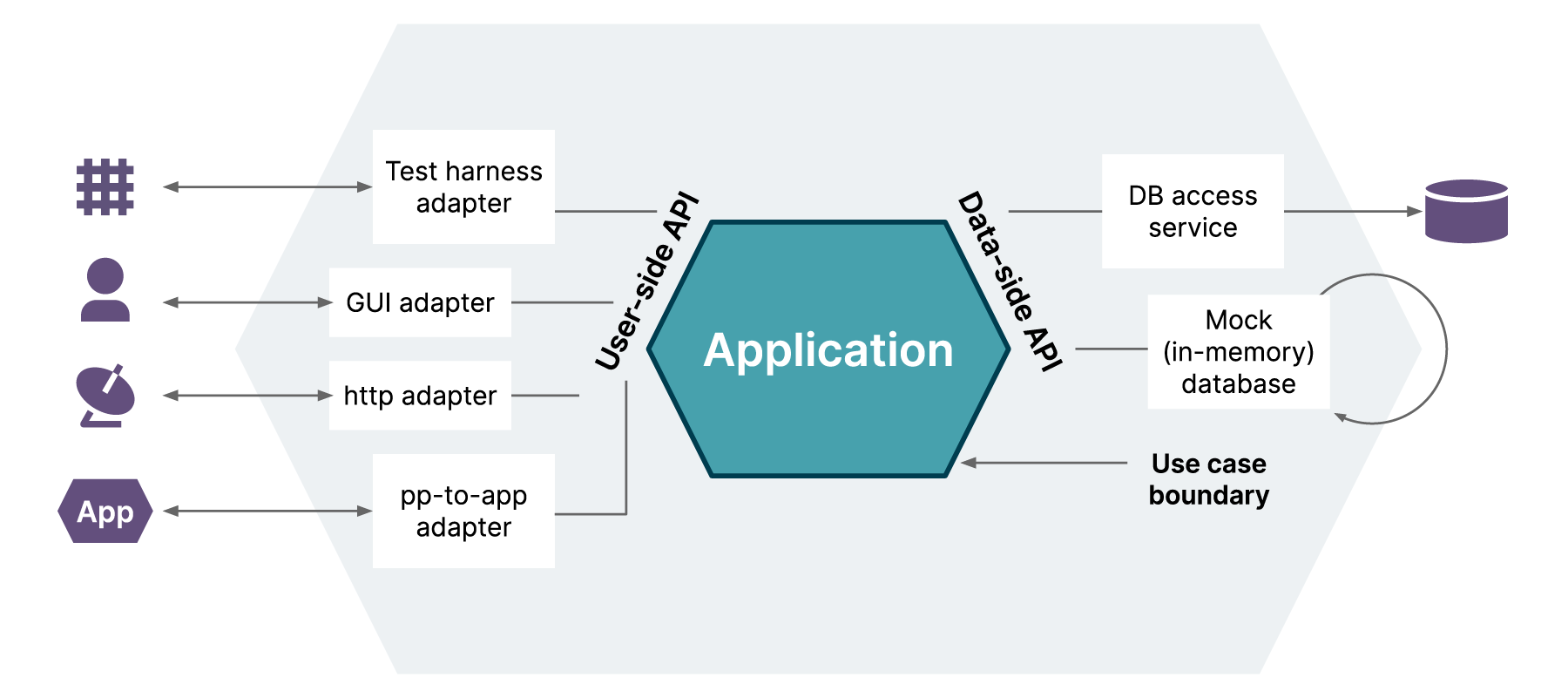
Hexagonal Architecture is sometimes referred to as ports and adapters architecture. Alistair Cockburn introduced it in 2005, with the core idea behind it being to make applications independent of direct dependency from UI and database.

I took this image from this thoughtworks blog post

In this architecture, the business logic resides in the center, isolated from the external systems and frameworks. The inbound ports represent the entry points into the system, where external requests are received and adapted to the domain objects. The outbound ports represent the exit points from the system, where domain objects are adapted to external requests and sent out. The adapters in the inbound and outbound ports are responsible for translating the external requests and responses into domain objects and vice versa. The infrastructure layer contains all the external systems and frameworks used by the system.

Example of Hexagonal Architecture

Consider a simple e-commerce application that allows users to browse and purchase products online. The application consists of a user interface, a database for storing product information and order data, and a payment processing service.

In a hexagonal architecture, the core of the application would contain the business logic for managing products, orders, and payments. This core would be surrounded by a set of ports and adapters that connect the application to the user interface, the database, and the payment processing service.

The user interface port would be responsible for handling user input and displaying output to the user. This port would define a set of interfaces that the user interface adapter would implement, allowing the application to be easily integrated with different user interface technologies such as web, mobile, or desktop applications.

The database port would provide a set of interfaces for storing and retrieving product and order data. The database adapter would implement these interfaces, allowing the application to be easily integrated with different database technologies.

The payment processing port would provide a set of interfaces for processing payments. The payment processing adapter would implement these interfaces, allowing the application to be easily integrated with different payment processing services.

The core of the application would not depend on any specific technology or framework, allowing it to be easily tested and ported to different environments. The ports and adapters would provide the necessary interfaces to allow the application to communicate with the outside world, making it flexible and extensible over time.

Benefits of Hexagonal Architecture
  1. Separation of concerns: Hexagonal architecture separates the application logic from external dependencies, allowing for better separation of concerns and greater modularity in the application.
  2. Testability: The core of the application in a hexagonal architecture is highly portable and easy to test, as it does not depend on any specific technology or framework.
  3. Flexibility: The ports and adapters in a hexagonal architecture provide the necessary interfaces to allow the application to communicate with external systems, making it flexible and adaptable over time.
  4. Maintainability: Hexagonal architecture makes it easier to maintain the application over time, as changes to external systems or dependencies can be easily integrated through the ports and adapters.
  5. Scalability: The modular nature of hexagonal architecture makes it easier to scale the application as needed, by adding or removing ports and adapters as necessary.

Conclusion:

hexagonal architecture is a powerful design pattern for creating flexible, modular, and maintainable applications. By separating the core application logic from external dependencies, hexagonal architecture allows for greater flexibility and scalability over time.

Hexagonal Architecture Pattern, Software architecture Tags:Hexagonal Architecture Pattern, ports and adapters architecture

Post navigation

Previous Post: Command Query Responsibility Segregation (CQRS) Pattern
Next Post: Pipeline Pattern

Related Posts

  • Common patterns used in Enterprise application architecture Enterprise application architecture
  • 10 most popular software architectural patterns Software architecture
  • Domain-Driven Design (DDD) Domain-Driven Design (DDD)
  • Microservices pattern Microservices
  • Event-Driven Architecture Event-Driven Architecture
  • Model-View-Controller (MVC) Pattern Model-View-Controller (MVC) Pattern

Leave a Reply Cancel reply

Your email address will not be published. Required fields are marked *

This site uses Akismet to reduce spam. Learn how your comment data is processed.


Categories

  • Agile Software development
  • AI Writing & Automation
  • Amazon EC2
  • Amazon Web Services (AWS)
  • Apache Kafka
  • API development
  • Apple Mac
  • ARM templates
  • Artificial intelligence
  • ASP.NET Core
  • ASP.Net MVC
  • Atlassian Jira
  • AWS Lambda
  • Azure
  • Azure Active Directory
  • Azure AD B2C
  • Azure AD Domain Services
  • Azure AI and ML services
  • Azure Analytics Services
  • Azure App Service
  • Azure Application Gateway
  • Azure Archive Storage
  • Azure Blob Storage
  • Azure Cache for Redis
  • Azure Cognitive Services
  • Azure Compute
  • Azure Container Instances (ACI)
  • Azure Core Services
  • Azure Cosmos DB
  • Azure Data and Storage
  • Azure Data Factory
  • Azure Data Lake Storage
  • Azure Database for MySQL
  • Azure Database for PostgreSQL
  • Azure Database Migration Service
  • Azure Database Services
  • Azure Databricks
  • Azure DDoS Protection
  • Azure Defender
  • Azure Devops
  • Azure Disk Storage
  • Azure ExpressRoute
  • Azure File Storage
  • Azure Firewall
  • Azure Functions
  • Azure HDInsight
  • Azure IaaS
  • Azure Identity and Access Management
  • Azure Internet of Things (IoT)
  • Azure Key Vault
  • Azure Kubernetes Service (AKS)
  • Azure landing zone
  • Azure Lighthouse
  • Azure Load Balancer
  • Azure Logic Apps
  • Azure Machine Learning
  • Azure Machine Learning
  • Azure Migration
  • Azure Mobile Apps
  • Azure Network Watcher
  • Azure Networking – VNET
  • Azure Networking services
  • Azure Pricing and Support
  • Azure Queue Storage
  • Azure Resource Manager
  • Azure Security
  • Azure Security Center
  • Azure Security Information and Event Management (SIEM)
  • Azure security tools for logging and monitoring
  • Azure Security, Privacy, Compliance, and Trust
  • Azure Sentinel
  • Azure Sentinel – Data connectors
  • Azure Serverless Computing
  • Azure Service Level Agreement (SLA)
  • Azure SLA calculation
  • Azure SQL
  • Azure SQL Database
  • Azure Storage
  • Azure Stream Analytics
  • Azure Synapse Analytics
  • Azure Table Storage
  • Azure Virtual Machine
  • Azure VPN Gateway
  • Blogging
  • Business
  • C# development
  • CDA (Clinical Document Architecture)
  • ChatGPT
  • CI/CD pipeline
  • Cloud
  • Cloud computing
  • Cloud Computing Concepts
  • Cloud FinOps
  • Cloud FinOps Optmisation
  • Cloud services
  • COBIT
  • Command Query Responsibility Segregation (CQRS) Pattern
  • Configure SSL offloading
  • Content Creation
  • Content management system
  • Continuous Integration
  • conversational AI
  • Cross Site Scripting (XSS)
  • cyber breaches
  • Cybersecurity
  • Data Analysis
  • Data Clean Rooms
  • Data Engineering
  • Data Warehouse
  • Database
  • DeepSeek AI
  • DevOps
  • DevSecOps
  • Docker
  • DOM-based XSS
  • Domain-Driven Design (DDD)
  • Dynamic Application Security Testing (DAST)
  • Enterprise application architecture
  • Event-Driven Architecture
  • git
  • gmail api
  • Google
  • Google Ads
  • Google AdSense
  • Google Analytics
  • Google Cloud Platform (GCP)
  • Google Docs
  • Google Drive
  • Google Flights API
  • Google Maps
  • Google search console
  • Healthcare Interoperability Resources
  • Hexagonal Architecture Pattern
  • IBM qradar
  • Internet of Things (IoT)
  • Interview questions
  • Introduction to DICOM
  • IT governance
  • IT Infrastructure networking
  • Kubernetes
  • Layered Pattern
  • Load Balancing Algorithms
  • Microservices
  • Microservices
  • Microsoft
  • Microsoft 365 Defender
  • Microsoft AZ-900 Certification Exam
  • Microsoft Azure
  • Microsoft Azure Log Analytics
  • Microsoft Cloud Adoption Framework
  • Microsoft Teams
  • Microsoft Teams
  • Model-View-Controller (MVC) Pattern
  • Monitoring and analytics
  • NoSQL
  • OpenAI
  • Peer-to-Peer (P2P) pattern
  • Pipeline Pattern
  • PL-100: Microsoft Power Platform App Maker
  • Postman
  • Project management
  • Rally software
  • Ransomware
  • Reflected XSS
  • RESTful APIs
  • Rich Text Editor
  • SC-100: Microsoft Cybersecurity Architect
  • Scrum Master Certification
  • Service-oriented architecture (SOA)
  • SIEM
  • Software architecture
  • Splunk
  • SQL
  • Static Application Security Testing (SAST)
  • Stored XSS attacks
  • System Design Interview
  • Test Driven Development (TDD)
  • TinyMCE
  • Top technology trends for 2023
  • Uncategorized
  • User Experience (UX) design
  • Version control system
  • virtual machine scale set
  • visual studio
  • Web development
  • Windows Hello
  • WordPress
  • WordPress developer interview questions and answers
  • Zero Trust strategy


Recent Posts

  • Ace Your FAANG System Design Interview like Google & Amazon: The 8 Whitepapers You Must Read
  • From $0 to $10K/Month Writing Online – The Exact Roadmap to Build a Profitable Writing Career
  • How to Write an AI-Generated Article That Feels 100% Human Using ChatGPT
  • DeepSeek AI: The OpenAI Rival You Didn’t See Coming (But Should)
  • 10 Ways AI is Revolutionizing Healthcare (And Why Your Doctor Might Just Be a Robot Soon)
  • Google Docs Google
  • Windows Hello authenticator Windows Hello
  • Azure Storage Azure Storage
  • What is an effective method to apply FinOps principles to SAAS products within an organization? Cloud
  • Cross Site Scripting (XSS) Cross Site Scripting (XSS)
  • Azure Network Watcher Azure
  • Futuristic AI battlefield depicting a head-to-head battle between DeepSeek AI and OpenAI, with glowing data streams, neural networks, and cyber elements showcasing the intense AI competition in 2025.
    DeepSeek AI: The OpenAI Rival You Didn’t See Coming (But Should) Artificial intelligence
  • Exam AZ-900 – AZURE FUNDAMENTALS Azure

Copyright © 2025 Desi banjara.

Powered by PressBook News WordPress theme